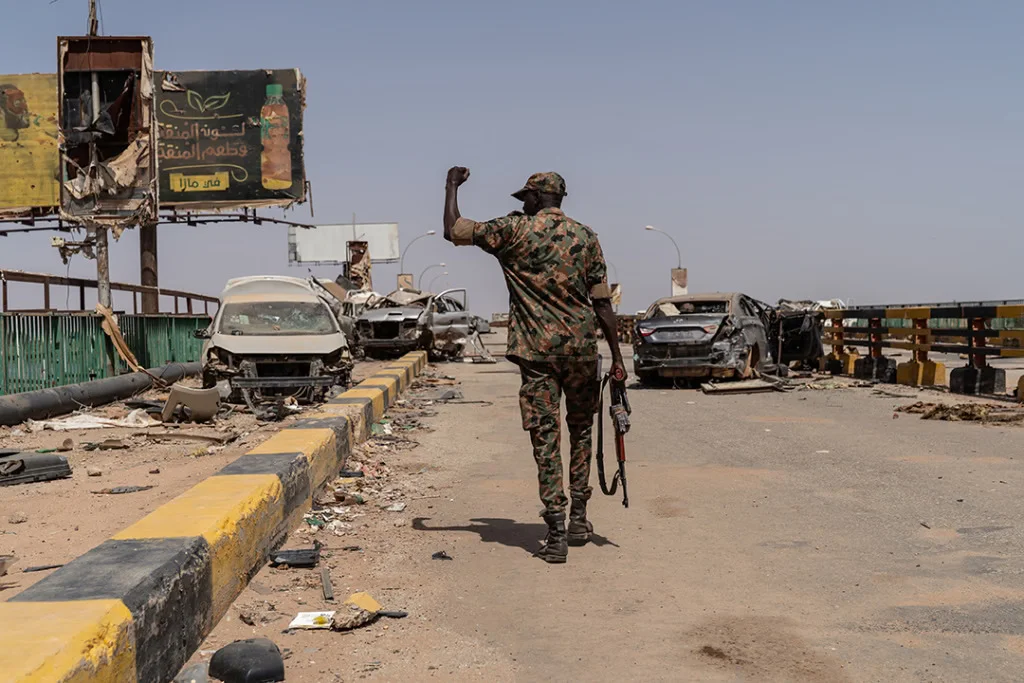
During 2026, the security of the Red Sea region went through (and continues to go through) a profound crisis: the war in Iran; tensions in Somalia surrounding the independence claims of regions like Somaliland; the civil war in Sudan; the conflict ahead of the December elections in South Sudan; the reawakening of latent conflicts in Yemen and Ethiopia; and the latter's friction with Eritrea, to name a few.
The blockade of the Strait of Hormuz and Houthi control of the Bab al-Mandeb Strait have deepened the strategic significance of the Red Sea in terms of maritime, food, and energy security. This reinforced the geopolitical importance of the Horn of Africa, especially for the political agendas of Saudi Arabia and the United Arab Emirates. However, the alignment of priorities has not produced a convergence on the strategic plane. The two Gulf monarchies have found themselves on rival sides in the conflict plaguing the Republic of Sudan.
The Sudanese Civil War: An Endless Spiral of Violence
In April 2019, after 30 years as head of state and more than four months where Sudanese people took to the streets demanding a democratic transition, Omar al-Bashir was deposed in a military coup led by the Sudanese Armed Forces (SAF), under the command of General Abdel Fattah al-Burhan, and the Rapid Support Forces (RSF), a paramilitary group led by General Mohamed Hamdan Dagalo, also known as Hemedti.
The fragile nature of this alliance deepened due to competition for political and economic influence, and General Dagalo's push for a more gradual integration of his forces into the formal military body to preserve their autonomy. The differences proved irreconcilable when, in April 2023, Sudan erupted into a civil war that has claimed the lives of over 150,000 people, forcibly displaced more than 12 million, and threatened the food security of another 26 million, in the worst humanitarian crisis today.
From the outset, the war became a regional conflict sustained by networks of external support and funding that instrumentalize the rivalry between national leaders. The military campaigns of both sides would not be sustainable without access to resources, weaponry, logistical corridors, and diplomatic support. Nor would they be possible without their respective alliances with numerous local actors and militias with parochial designs, sometimes reflecting an ethnic or religious identity, but, above all, economic interests.
Riyadh and Abu Dhabi's Geopolitical Ambitions in Sudan
Between 2023 and early 2025, the Saudi government tried to establish itself as the main driver of mediation efforts. Mohammed bin Salman's first approach to the war was rather cautious, avoiding extending military support to either party.
The initial Saudi position boosted assertive Emirati involvement. Since the beginning of the conflict, Abu Dhabi has emerged as the dominant actor on the Sudanese chessboard. Its animosity towards Islamist groups, with whom the SAF have a complex and close relationship, led Emirati officials to close ranks with Hemedti. This general proved to be a mercantile warlord specialized in using violence to secure political and economic capital in strategic scenarios.
General Dagalo has a quasi-monopoly over Sudan's two most lucrative businesses, gold and mercenarism, which have enabled him to establish himself as a relevant political actor challenging central authority. According to reports, gold escapes the formal economy through companies located in the Emirates and managed by the RSF, with the Dubai market – the main global hub for gold trade – as its destination. A SWISSAID (2026)[1] report based on United Nations information revealed that, in 2024 alone, the Emirates imported at least 453 tons of undeclared gold from Africa, highlighting that from Sudan, Guinea, and Mali.
Various multilateral organizations and governments have accused the Emirates of sending mercenaries, funding, and weaponry to the RSF through a network of corridors that crosses territories in Libya, Chad, Kenya, Uganda, and Rwanda.
Al-Burhan's government even took the Emirates to trial at the International Court of Justice for its support of Hemedti. Although Emirati responsibility was dismissed, the accusations have damaged Abu Dhabi's credibility.
During the first 18 months of the conflict, the RSF captured most of the country, including Khartoum. However, the SAF retook the capital in March 2025 thanks to the re-establishment of relations with Tehran, a strategic necessity to obtain military assistance (such as Mohajer-6 drones).
The occupation of Khartoum, coupled with growing Saudi disillusionment with assertive Emirati behavior, attracted political and military support from Riyadh to consolidate the authority and legitimacy of the government led by al-Burhan. Prince Salman urged Donald Trump to increase pressure on Mohammed bin Zayed to reduce his role in Sudan and attempted to dismantle the logistical supply networks, limiting the use of Saudi airspace and African land. Rapidly, the army began to dominate the theater of operations, but without managing to penetrate the Darfur region, an RSF stronghold after the capture of El Fasher in October 2025.
To this day, the developments in Darfur are giving momentum to the SAF's offensives. General Dagalo's ranks have suffered a devastating blow due to a series of defections, among which stand out those of Omar Osman Jabura and Ammar Mohammed Zein Rabah, who denounced the Israeli presence in the city of Nyala to train the RSF in cybersecurity. The weakening of the opposing side has allowed the SAF to advance into enemy territory, dominating El Obeid and approaching El Fasher.

The Complexification of the Horn of Africa's Security Fabric
Sudan is the clearest manifestation of the growing intertwining between the security dynamics of the Horn and the Arabian Peninsula. Saudi support for the SAF not only failed to reduce Emirati support but also had the indirect effect of extending the conflict beyond Sudanese territory. Supplies now arrive via alternative routes.
Since late 2025, there has been an increased flow of flights from the Emirates to Ethiopia, a country that hosts a military base financed by Abu Dhabi which, according to accusations from al-Burhan's government, has served as a platform for bombings in Sudan and where RSF soldiers have been trained.
For its part, Ethiopian authorities have accused the SAF of supporting the Tigray People's Liberation Front. In September of this year, the peace agreement reached between Addis Ababa and regional forces in 2022 was scrapped, and hostilities resumed. Insurgent militias have seen their contingents strengthened by troops from Eritrea. Ethiopia stated its right to defend itself against Eritrean hostilities at the United Nations, but the intervention of international authorities temporarily prevented escalation.
Eritrea, for its part, has tried to pivot from a strategic alignment with the Saudi Kingdom. However, Prince Salman has modified his position since the beginning of the war in Iran to concentrate Saudi efforts on maintaining stability in the Red Sea, avoiding the fragmentation of Sudan, and protecting his ties with Washington.
The United States imposed a new package of sanctions on the Sudanese government in July of this year. General al-Burhan has little to lose because the country barely exports to North America, has no active financing lines, and there are no direct flights to US territory. However, the pressure does affect his allies. Riyadh has become less reckless in granting political-military support, as evidenced by its request to Islamabad for the cancellation of an arms transfer agreement between Pakistan and Sudan, valued at some 1.5 billion dollars, which was to be financed by the Kingdom. The political cost of being associated with a military group with undeniable ties to Iran and allied with the Sudanese Muslim Brotherhood and the al-Bara Bin Malik Brigade, declared terrorist organizations by the United States this year, is extremely high.
Towards the Redefinition of War
The institution of war is undergoing an accelerated process of transformation. Drones have established themselves as the preferred weapon, completely modifying the theaters of operations. They lower military costs, facilitate ground operations, minimize allied casualties, and suffocate the opposing side through the destruction of electricity, water, and fuel supply networks.
This technology, refined in Ukraine and Gaza, does not distinguish between belligerents and civilians. Most attacks have taken the form of “double-tap,” designed to maximize casualties. According to the United Nations, drone attacks in the Kordofan, Darfur, Blue Nile, and Khartoum regions have caused the deaths of at least 880 civilians (more than 80%) between January and April of the current year alone.
No Horizon for Peace
Both Riyadh and Abu Dhabi aim to establish themselves as the dominant actor in the Horn of Africa, hindering progress in the International Conferences for Sudan. Saudi Arabia insists that any agreement must emphasize the need to preserve state institutions (the SAF), but Emirati opposition has prevented an agreement from being reached.
The SAF rejected the joint proposal extended in September 2025 by Saudi Arabia, the United States, Egypt, and the Emirates (a group known as the QUAD) for a humanitarian truce, a ceasefire, and the establishment of a civilian government, because they believe they have the advantage in a conflagration. Recently, the Sudanese government rejected Ethiopia's mediation offer, whom it considers a nexus for the flow of weapons, mercenaries, and drones.
Hemedti was repeatedly sentenced to death in absentia by the state court in Port Sudan. The charges include looting, destruction of medical facilities, war crimes, and genocide. A military victory by al-Burhan would mean the death of his rival – or his escape to, probably, Ethiopia or the Emirates. The path to lasting peace is still a chimera buried under a rain of ammunition.
The geoeconomic and geopolitical competition between Saudi Arabia and the United Arab Emirates has been instrumental in the securitization of the region and the prolongation of the conflict. Security problems in the Horn of Africa and Red Sea region can no longer be analyzed or resolved in isolation. Sudan is an example of a trend that has been exacerbated since the 1970s: conflicts, based on attrition strategies, are increasingly prolonged and less frequently concluded.
Wars are no longer won or lost; instead, they remain inconclusive, and a permanent latent conflict becomes normalized.
Notas al pie
- [1]Ummel, M., & Schulz, Y. (2026). Laundered in the Emirates: Why the UAE remains a problematic gold-trading hub. SWISSAID. https://www.swissaid.ch/wp-content/uploads/2026/11/2026-SWISSAID-Report_Laundered_in_the_Emirates_web.pdf
§ Bibliografía
Las referencias bibliográficas de esta nota se listan al pie. Para citar la pieza con formato APA/BibTeX/RIS, usá "Citar este artículo" abajo.